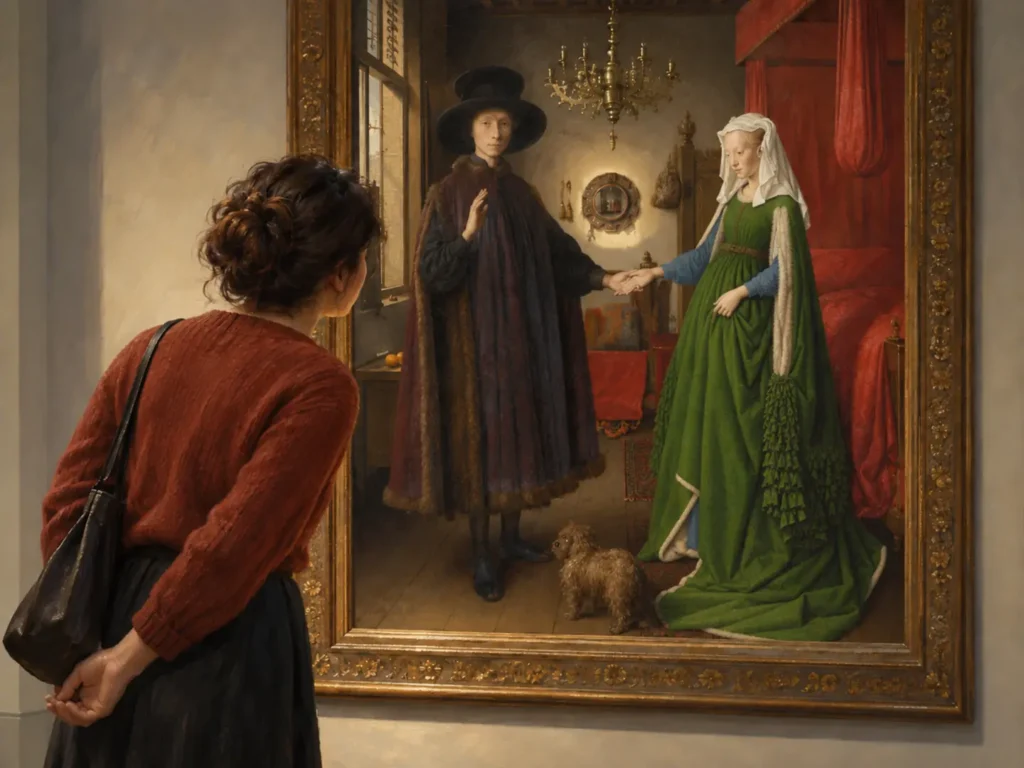
At first, the painting seems easy enough to take in. A wealthy man in a dark hat stands beside a woman in a magnificent green dress. A small dog occupies the floor between them with the calm confidence of an animal that knows it belongs in the family portrait.
Then your eye reaches the back wall.
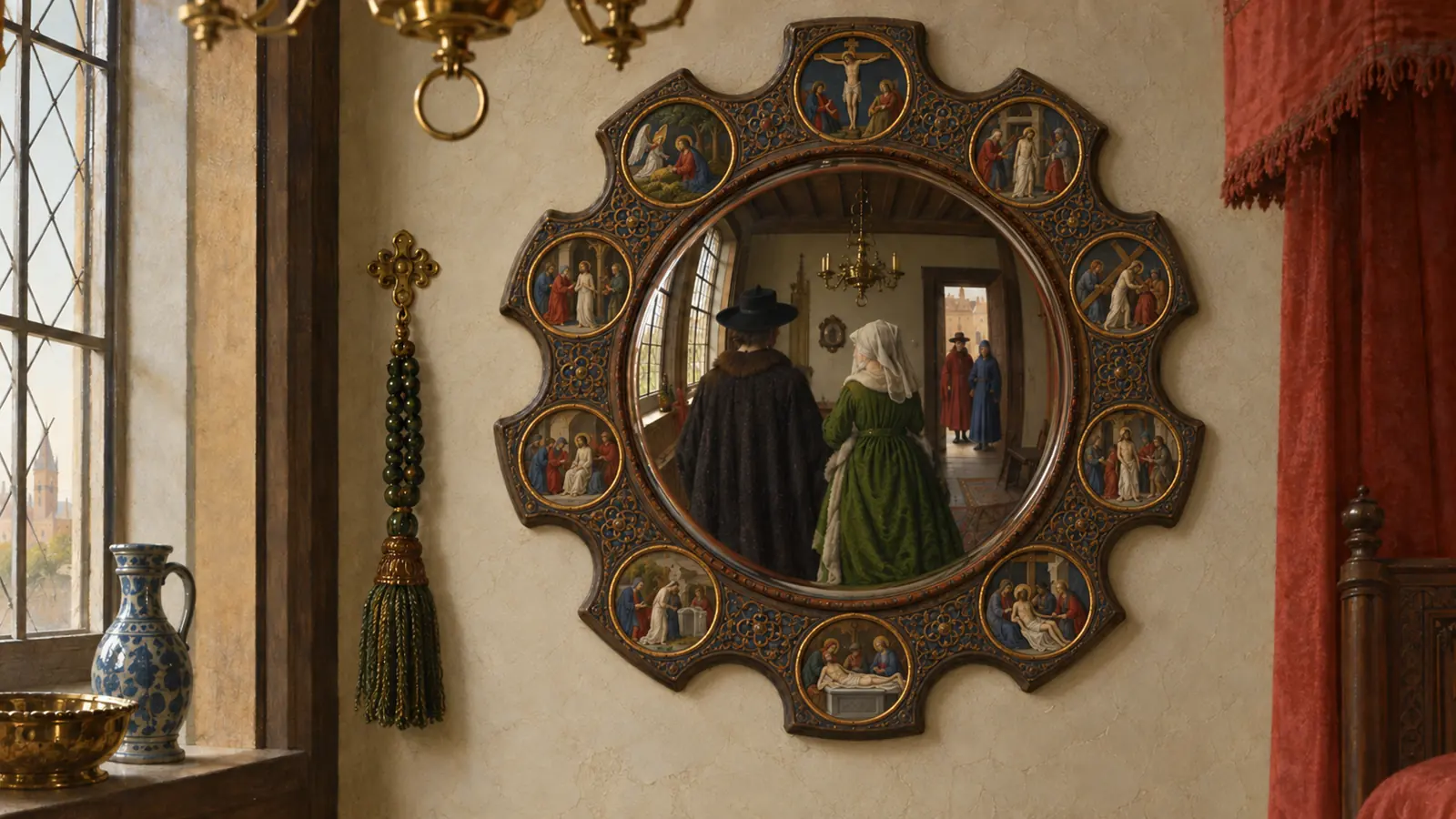
There, directly between the couple, is a round convex mirror. It is tiny in the painting—surrounded by a dark frame and ten miniature scenes—but it opens the room in a way no ordinary window could. Inside its curved glass are the couple’s backs, an open doorway we cannot otherwise see, and two additional people entering the room.
The mirror does not merely add a clever reflection. It changes our understanding of who is present, where we are standing, and what sort of moment Jan van Eyck has painted.
First, find the two people everyone misses
The Arnolfini Portrait is only about 32 inches high. The mirror within it is roughly the visual size of a cookie, depending on how close you are standing. Yet Van Eyck managed to place an entire second view of the room inside it.
Look closely and you can make out four figures:
- the man in the dark robe, seen from behind
- the woman in green, also seen from behind
- a visitor dressed in red at the doorway
- another visitor in blue, a little farther back
One of the visitors appears to lift an arm, echoing the raised hand of the man in the foreground. The National Gallery suggests a tantalizing possibility: perhaps the nearer visitor is Van Eyck himself, arriving with a servant or assistant. It is a possibility, not an established identification—which is part of the mirror’s enduring fun.
The reflection also reveals something else. The doorway is exactly where we, the viewers, seem to be standing. The painting invites us to borrow the visitors’ position, as though we have arrived at the threshold a moment after them.
Six centuries later, the door is still open.
Ten pictures around one tiny mirror
The frame deserves its own close look. Around the glass are ten small roundels—little circular images depicting scenes from the Passion of Christ. Each one is smaller than a fingernail in the original painting.
This is where reproductions can betray the picture. On a phone screen, the frame may look like a row of decorative bumps. In a high-resolution scan, the bumps resolve into miniature narrative paintings. Van Eyck painted a detailed portrait, then placed another room inside that portrait, then ringed the second room with ten more pictures.
It is a slightly absurd display of control. Also a wonderful one.
Above the mirror, in elaborate script, Van Eyck wrote: Johannes de Eyck fuit hic. 1434. The National Gallery translates this as “Jan van Eyck was here. 1434.” It does not read like a conventional signature tucked discreetly into a corner. It reads more like a mark left on the room itself.
That wording helped inspire one of the painting’s most famous theories: that Van Eyck had witnessed a marriage and signed the picture as a kind of visual legal record. For years, many art-history books treated the scene as a wedding ceremony.
Current National Gallery interpretation no longer does.
So this is not a wedding certificate?
Probably not. The couple appear to be husband and wife, but the museum does not regard the painting as a depiction of their marriage ceremony. Nor does it treat the signature as proof that Van Eyck witnessed a legally significant event.
The people are probably Giovanni di Nicolao di Arnolfini, an Italian merchant living in Bruges, and his second wife, whose name is unknown. Even that identification carries a question mark in the painting’s official title: Portrait of Giovanni(?) Arnolfini and his Wife. The uncertainty is worth keeping. This painting has attracted confident explanations for nearly six hundred years; not all of them have survived.
The woman is not shown as pregnant, either. She is lifting a great quantity of heavy green fabric in front of her body, a fashionable pose that appears in other fifteenth-century images. Once someone tells you the painting shows a pregnant bride, it can become difficult to see anything else. But the shape comes from the dress and the way she holds it—not evidence of a pregnancy.
The objects in the room have also collected symbolic meanings over time: the dog as fidelity, the single flame as divine presence, the discarded overshoes as a sign of holy ground. Some of these readings may be suggestive. None should distract from the more visible fact that the room is advertising wealth.
The oranges were expensive. The oriental carpet, fur-trimmed clothing, brass chandelier, enormous red-covered bed, carved furniture, and elaborate mirror all tell us that this household has money and wants visitors to know it. Not royal money—the walls are plastered, and the floor is made of boards—but the comfortable, internationally connected wealth of a successful merchant.
The room looks real because Van Eyck cheated beautifully
The mirror is often praised as evidence of Van Eyck’s almost photographic accuracy. That is true in spirit and misleading in practice.
The room is convincing, but it is not a neutral record of an actual interior. The National Gallery points out that the chandelier would not fit the space as painted, the bed is too short, no fireplace is visible, and the convex mirror seems impossibly large. Van Eyck may have based it on a mirror the couple owned, then enlarged it and made the frame more splendid because the picture needed something better.
In other words, the realism is constructed. Van Eyck adjusts the world until it looks more persuasive than the world itself.
Technical examination makes that process even more interesting. Infrared imaging has revealed the drawing beneath the paint. Many details now treated as essential “symbols”—including the chandelier, beads, chair, dog, and discarded shoes—were not part of the first underdrawing. Van Eyck added them later as the painting developed. He also changed the figures’ faces, feet, clothing, and positions.
That does not make those objects meaningless. It does make rigid, one-to-one decoding feel risky. The painting was designed, revised, and improved by an artist making visual choices—not assembled from a fixed checklist of secret signs.
Oil paint helped, but the real trick was Van Eyck
Van Eyck was once credited with inventing oil painting. He did not. Oil-based paint existed before him.
What he did extraordinarily well was use it to imitate how different surfaces receive light: the soft fur on a sleeve, the hard gleam of brass, translucent beads against a pale wall, an orange reflected in polished wood, and a curved mirror compressing a room.
The materials themselves were not exotic. According to the National Gallery, there is nothing unusual about the pigments in the picture. The astonishing effect comes from how Van Eyck handled them. In places he worked with the point of a brush; elsewhere he used a brush handle, his fingers, or quick touches of paint. A thumbprint survives near the shadow of the dog’s leg.
That small physical trace is a nice companion to the grand inscription above the mirror. “Jan van Eyck was here,” the wall announces. And, in the paint, he quite literally was.
How to look at it in 30 seconds
If you see the painting at London’s National Gallery—it is currently displayed in Room 52—start with the chandelier and move your eyes straight down to the mirror.
First find the couple’s backs. Then look between them for the open doorway and the flecks of red and blue that become two visitors. Move outward to the ten painted roundels around the frame. Finally, look just above it and read the swooping signature across the wall.
Online, use the National Gallery’s high-resolution image rather than a small reproduction. Zoom in until the mirror fills the screen, then zoom back out. That last movement matters. It lets you feel how much Van Eyck hid inside such a small part of the whole.
The mystery of the Arnolfini Portrait is not that one secret interpretation remains to be cracked. It is that the painting keeps producing questions even after several famous answers have fallen away.
The mirror gives us the clearest one: who has just walked into the room?
Van Eyck leaves those visitors small enough to debate, but visible enough that we cannot ignore them. And because they stand where we stand, looking in, the painting quietly makes visitors of us too.