
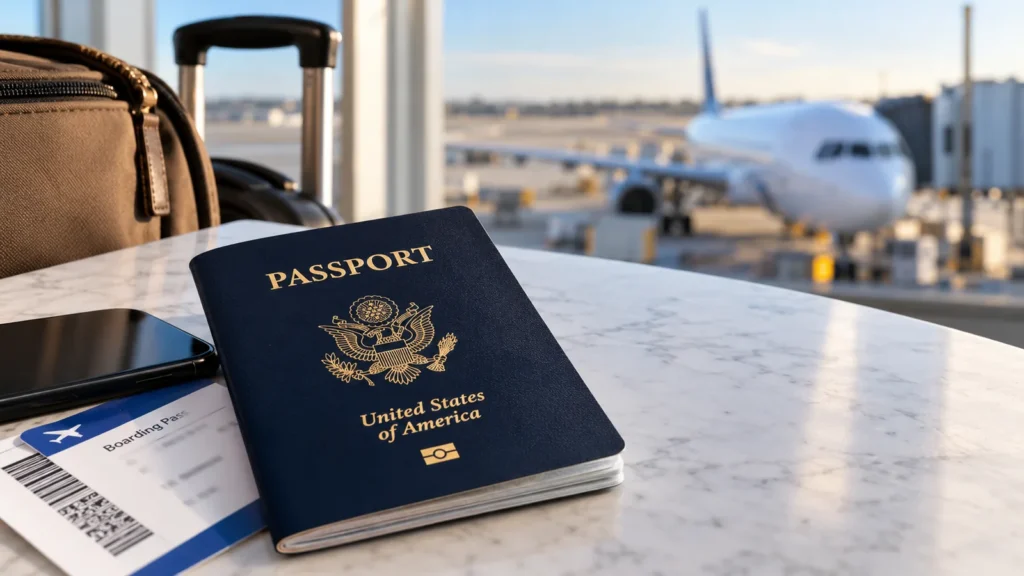
Not on the passport you’re renewing.
The State Department’s instruction is firmer than “don’t plan on it”: do not use your most recent passport after you renew it online. State cancels, or invalidates, the passport you’re renewing after you submit the application, and you cannot use it for international travel after that.
And here is the part that is unusually easy to misunderstand: the old passport may still be sitting in your house.
Unlike a renewal by mail, online renewal does not require you to mail the old passport to the State Department. You keep it. It still looks like a passport. Its printed expiration date may even be months away.
But keeping the booklet is not the same thing as keeping it usable for international travel.
Six weeks is the eligibility rule, not necessarily your safety margin
The State Department currently requires online-renewal applicants to be at least six weeks away from international travel when they submit the application.
It’s tempting to turn that into a planning rule: My trip is six weeks away, so I’m fine.
That’s not quite what State is saying.
The six weeks is the minimum requirement for being eligible to apply online. State separately lists routine passport processing at 4–6 weeks, and says it may take up to another two weeks to receive the passport after it is mailed.
Put those numbers together and the ordinary process can stretch to about eight weeks from application to passport in hand.
There is optional 1–3 day return delivery for a passport book, but the larger point remains: don’t treat six weeks as a guaranteed delivery window. It is the minimum travel-free period State requires for online renewal, not a promise that your new passport will arrive by the end of week six.
So if you’re staring at an airline reservation and thinking, I can renew now because I’ll still have my old passport, that’s the trap.
You will still have the booklet.
You won’t still have a passport you can use for that international trip.
Why do I keep the old passport if I can’t travel with it?
Because State doesn’t need you to surrender it for an online renewal.
The department specifically tells online applicants not to mail the passport being renewed. Instead, you keep it, and State invalidates it after the application is submitted.
That distinction makes perfect administrative sense.
It is less intuitive when you’re looking at a perfectly normal blue booklet with a future expiration date printed inside.
What if I’m renewing a passport card instead?
The online system isn’t limited to passport books.
If you’re eligible, you may be able to renew your most recent passport book, passport card, or both online. The State Department’s cancellation warning applies to the passport you are renewing: after submission, it will cancel or invalidate that passport.
So whether you’re renewing a book, a card, or both, don’t assume the old document remains usable merely because State lets you keep it.
What if I already renewed online and now need to travel?
This is where the answer depends on how soon you’re leaving.
If you’ve already applied and you’re traveling internationally in 14 days or less, call the National Passport Information Center at 877-487-2778. State then determines whether there is enough time to issue the passport or whether you need an appointment at a passport agency or center.
Appointments are required for urgent service at an agency or center, and availability is not guaranteed.
If you’re traveling in more than 14 days, State says to call NPIC if you want expedited service or 1–3 day delivery of your completed passport.
That deserves a little explanation because the government’s own wording can initially sound contradictory.
Before you apply, State says online renewal is for routine service and that online renewals cannot be expedited. But its instructions for people who have already submitted an application and then have a change in travel plans tell them to contact NPIC about expedited service.
In other words, don’t build your original travel plans around getting an online renewal expedited. But if you’ve already applied and an unexpected trip comes up, don’t assume there is nothing you can do.
Most importantly, don’t fall back on the old passport simply because it’s still in your possession. State has already told you not to use it after renewal.
Don’t pay someone who promises to magically fix it
A looming flight has a way of making expensive promises sound reasonable.
Be particularly careful with private passport websites and expeditors.
There is only one authorized website for submitting a U.S. passport renewal online:
opr.travel.state.gov
The State Department warns that any other website claiming to offer online passport renewal should be considered a scam. Some private companies also charge extra fees for passport-related services, which means you’re handing over both money and unusually sensitive personal information.
Private courier and expeditor companies do exist, including companies registered with State for certain services. But State says using one will not get your passport processed faster than applying at a passport agency yourself.
And nobody should be charging you merely to obtain a State Department passport-agency appointment. State does not charge a fee to make one.
What if the trip is an actual emergency?
There is a separate process for qualifying life-or-death emergencies.
The State Department defines this narrowly: you need international travel within the next two weeks because an immediate family member outside the United States has died, is dying or in hospice care, or has a life-threatening illness or injury. Documentation of the emergency and proof of travel are required.
That’s different from ordinary urgent travel.
A suddenly scheduled vacation, business trip or wedding may create a very real passport problem, but it doesn’t automatically become a State Department “life-or-death emergency.”
For other urgent international travel, follow the State Department’s urgent-travel instructions and contact NPIC as directed.
What about domestic flights?
This rule covers international travel. If you’re flying domestically while your renewal is pending, bring another TSA-accepted ID rather than counting on the passport you’re renewing.
The check to make before you click Submit
Online renewal really does remove one annoying part of passport renewal: you don’t have to put your existing passport in an envelope and send it away.
Unfortunately, that convenience makes the most important restriction easier to overlook.
Before submitting, look at your calendar—not just the expiration date in your passport.
State requires at least six weeks without international travel to qualify for online renewal. But routine processing can take 4–6 weeks, and return mailing can add up to another two weeks. If your schedule is tight, those are the numbers that matter.
And once you’ve submitted, don’t treat the passport sitting in your drawer as a backup plan.
It may look exactly as it did yesterday.
Its travel status is what changed.
Sources
U.S. Department of State — Renew Your Passport Online. Last updated September 30, 2026.
https://travel.state.gov/en/passports/renew-replace/online.html
U.S. Department of State — Get Your Processing Time. Last updated October 5, 2026.
https://travel.state.gov/en/passports/apply/help/processing-time.html
U.S. Department of State — Contact U.S. Passports. Last updated September 22, 2026.
https://travel.state.gov/en/passports/contact-support/us-passports.html
U.S. Department of State — Make an Appointment at a Passport Agency. Last updated October 15, 2026.
https://travel.state.gov/en/passports/apply/get-fast/make-appointment.html
U.S. Department of State — Get a Passport If You Have a Life-or-Death Emergency. Last updated October 7, 2026.
https://travel.state.gov/en/passports/apply/get-fast/life-or-death-emergencies.html
U.S. Department of State — Using a Passport Courier Company. Last updated September 28, 2026.
https://travel.state.gov/en/passports/apply/get-fast/courier-company.html