
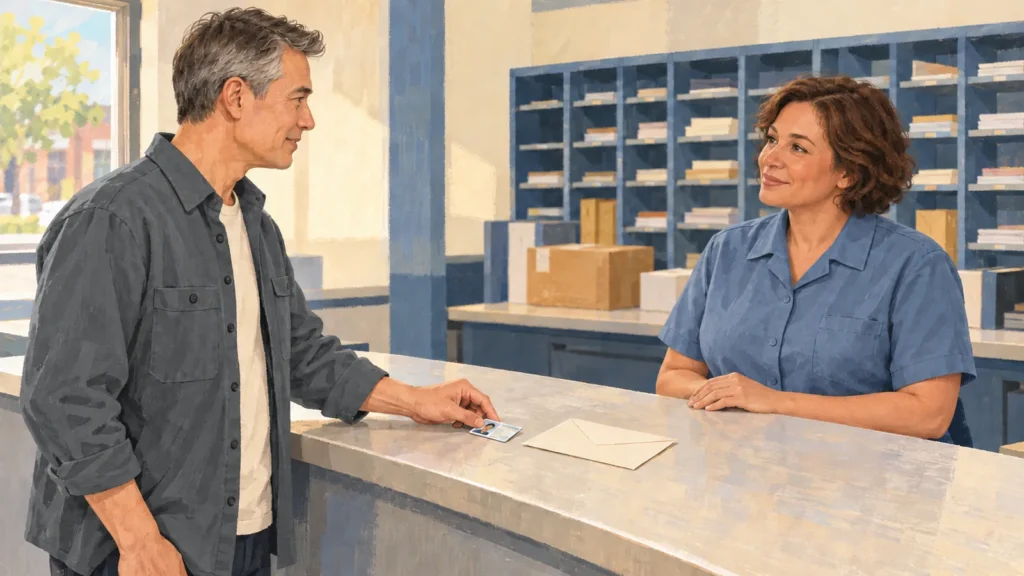
You filled out the address-change form. Then USPS told you to bring identification to a post office. Before you make the trip, check what the message actually asks you to do: a request to finish identity verification needs action; an ordinary move-confirmation letter serves a different purpose.
For a USPS change of address identity verification visit, bring your proofing instructions and barcode, a current acceptable photo ID, and any additional documents the instructions require. If your photo ID does not provide acceptable address identification, USPS may also require a second document to establish the address. Two documents are not automatically required from everyone.
First, check whether you need to go
USPS still allows people to complete an address change online. Its current filing rules direct customers to an authorized post office when online identity verification is unsuccessful. A counter visit is a fallback, not a new requirement for every online applicant.
The USPS forwarding instructions distinguish two outcomes: successful online verification brings an emailed confirmation code; unsuccessful verification brings an email with instructions and a barcode for an in-person visit. The online identity-verification fee is currently $1.25. Paying it does not replace a subsequent instruction to finish verification.
Paper forms can leave a step unfinished, too. If you mailed or submitted PS Form 3575 without completing authentication at the counter, USPS says it sends a letter directing you to finish online or in person.
Read the action requested, rather than treating every USPS letter as the same kind of confirmation. A Move Validation Letter goes to the old address; a Customer Notification Letter goes to the new one and contains the confirmation code used to manage the request. Neither name alone means you have been summoned to a counter.
What to put in your folder
Start with the instructions for your change-of-address request. USPS also verifies identities for other government services, whose document requirements can differ. Its in-person proofing FAQ directs customers to the relevant service’s instructions and says enrollment emails specify the required documents.
For your visit, prepare:
- The proofing email or letter and its barcode. Keep the complete instructions available so the clerk can see which request you are completing.
- A current acceptable photo ID. Common options include a state driver’s license or state non-driver ID, a passport, or a Uniformed Services ID. These appear in the USPS identification rules. Take the original, unexpired document.
- Address evidence if needed. When the primary ID does not contain acceptable address identification, USPS may require secondary identification. Its list includes a lease, mortgage or deed of trust; voter or vehicle registration; or a home or vehicle insurance policy. Choose a current document that supports the address you need to establish, and check it against your notice before leaving.
A passport can establish identity without establishing your street address. That is a reason to prepare address evidence alongside it, not a reason to assume the passport is unusable.
Don’t substitute a phone image of your ID. The USPS identification FAQ says digital and electronic identification are not accepted. Nor should you assume that any document with your address qualifies: a utility bill is not on that FAQ’s accepted secondary-ID list. A lease or vehicle registration is a better choice when you need address evidence.
If you cannot provide the required identification and verify your identity in person, USPS says it cannot complete the address change. Your only option then is to give your new address directly to everyone who sends you mail. If you’re unsure whether a document qualifies, ask the post office before making the trip. The checklist cannot guarantee acceptance of a particular document.
If you are handling someone else’s move
Your ID establishes who you are. It does not, by itself, establish your authority to redirect another person’s mail.
The change-of-address FAQ says authorized agents must present their own valid primary photo ID, file in person and supply authorization documents. For a minor child, it lists a birth certificate or a legal document showing custody or guardianship; for someone unable to act for themselves, Power of Attorney or guardianship; for a deceased person, executor or court-appointed representative documents. USPS separately warns that a death certificate alone is insufficient.
There is also a name-mismatch case: if you are filing for yourself but your primary photo ID has a different last name, the FAQ calls for supporting marriage or divorce documents. Pack those with your ID rather than expecting the clerk to infer the connection.
Check your notice, and keep updating your senders
If your notice gives a completion date, follow it. If that date has passed, or the instructions are unclear, take the notice to USPS and ask what is needed to complete the address change. Don’t assume the request is active because you submitted a form or paid the online fee.
Once the request is approved, USPS says to allow at least seven to ten business days for it to take effect. That is not a delivery guarantee for each forwarded item. Some mail will not follow you: a sender can instruct USPS to return an undeliverable item instead of forwarding it. The COA FAQ explains that exception.
Update important senders directly while you resolve the forwarding request. USPS emphasizes that its address change does not update your address with every company or government agency. If a bank statement or other expected document is missing, ask the sender about that item rather than assuming one more verification visit will fix it.
The useful distinction is between an unfinished identity check and mail that is delayed or cannot be forwarded. Bring the notice and the right evidence to resolve the first. Keep your senders informed to reduce your dependence on the second.