
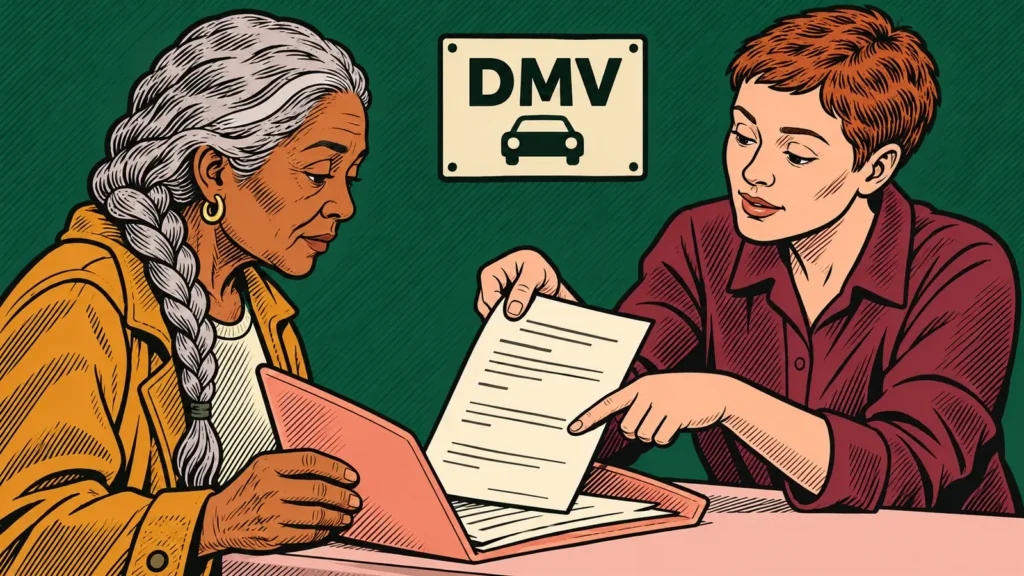
Having your REAL ID documents rejected can leave you wondering what else to bring. Before you order new certificates or make another appointment, find out which requirement failed—and whether a document you already have can meet it. A missing name-change record, an outdated bill and a Social Security verification mismatch need different fixes.
There isn’t one nationwide folder that works for everyone. Federal rules set the requirements for REAL ID; states specify the documents and procedures they accept. A tip from someone who succeeded in another state can still send you on an unnecessary errand.
Flight coming up? Handle that separately. Our guide to flying without a REAL ID covers the airport ID problem while you work on the DMV paperwork.
Official guidance checked November 1–2, 2026. State examples below illustrate differences; use your own state’s current REAL ID checklist for your application.
First, get a useful explanation of the rejection
Ask the office to identify the rejected document and the specific problem. If you’re already home, use your application notice or contact the agency through its official website. Start with the explanation you were given:
- Names don’t match: Which two records disagree? Is a legal name-change document missing, or does an agency record need updating?
- Address proof doesn’t count: Is the problem the address, name, issue date, document type or combination of proofs?
- Certificate isn’t acceptable: Does it need government certification, a different record format or replacement because of damage?
- Social Security information didn’t verify: What information failed to match, and which agency must correct it?
- Verification is still pending: Is anything missing, or should you follow a verification process already underway? Ask what happens next and how to check its progress.
Then open your state’s REAL ID checklist—not its standard-license list. USAGov’s motor vehicle agency directory gets you to the responsible state agency. Save the relevant instructions alongside the rejection notice.
The federal rule covers identity, birth date, Social Security information, lawful status and residence. It also requires evidence when the requested name differs from the identity source document. It doesn’t make every state’s document list identical.
If the names don’t connect, start with your identity document
Look at the name on the identity document you plan to use. Is it already your current legal name?
That question can save you from ordering records you don’t need. Pennsylvania explicitly says that name-change documents aren’t needed when the current legal name already appears on the identity document, such as a passport. Check whether your state offers that route before rebuilding your entire name history.
If you’re using a birth certificate in an earlier name, write down the changes in order. Suppose you were born Jane Doe, changed to Jane Smith when you married, and later changed to Jane Johnson in another marriage. If your second marriage record identifies you as Smith, it doesn’t by itself explain the move from Doe to Smith.
In a state requiring those links, put the accepted record beside each change. A divorce in between isn’t automatically another name change: if you kept Smith after the divorce, there was no return to Doe to document. Pennsylvania, for example, asks for marriage certificates showing each marriage-related name change, but divorce papers only if you went back to your maiden name.
Don’t assume every state demands every marriage record. Kansas’s REAL ID FAQ says applicants married multiple times need only the most recent one. Describe your actual names and records to your own DMV before paying for missing copies.
If a divorce decree is supposed to prove that you resumed a former name, check what it actually says. Kansas lists a decree with the name restored; California lists dissolution documents containing the legal name resulting from the court action. If yours is silent, ask which alternative the state accepts. Don’t assume that proving a divorce also proves a particular name change.
Order the official record the office actually needs
A wedding keepsake and a certified civil marriage record aren’t interchangeable. Pennsylvania, for example, rejects commemorative marriage certificates and requires a certified record from the appropriate county office.
Use the CDC’s vital-records directory to locate the jurisdiction holding the record. For a marriage certificate, USAGov directs you to the state where you married. For a divorce decree, contact the clerk where the divorce occurred; a divorce certificate and the court’s decree are different records.
Check the issuing office’s fees, eligibility and processing options before paying. There is no single national replacement fee or delivery time.
If residency proof failed, check the pair together
Two pieces of mail aren’t necessarily two acceptable proofs. Read the checklist for the document’s type, required name and address, age limit and any restrictions on using documents together.
Check the date for that particular document. The permitted age varies by state and document type:
- Illinois lists utility bills issued within 90 days of application.
- Texas allows utility or residential service bills dated within 180 days of application.
- New York says bank statements and utility bills used as residency proof must have been issued within 365 days of the DMV visit.
Use the cutoff on your state’s list for the proof you’re bringing.
Check the combination. Texas doesn’t accept statements for the same service from different months. It does allow separate water and gas statements from the same municipal utility. A rule against duplicate statements isn’t necessarily a rule against every document from the same provider.
Check the address rule. A P.O. Box alone may be the problem, but don’t assume all P.O. Box documents are useless. California’s checklist allows one document showing only the P.O. Box if the other shows both the P.O. Box and physical residence address. Follow your state’s instructions for your situation, including any protected-address procedure.
If the bills are in someone else’s name
Before adding yourself to an account and waiting for another billing cycle, look for other accepted documents you already have: perhaps a lease, insurance document or vehicle registration. Acceptance depends on your state’s list.
If you still lack proofs in your own name, check the state’s family or residency-certification route. California’s general checklist describes a relationship route. You could use a birth certificate connecting you to the parent named on the bills, or a marriage license connecting you to a spouse. The names must connect; if the name on the bill differs from the relationship record because of a name change, additional name-change evidence is required. That isn’t a general permission to bring a roommate’s bill.
Texas’s DL-5 residency affidavit has different instructions for relatives, unrelated people and service organizations. An unrelated person certifying that you live with them must accompany you and present acceptable identification; supporting residency documents are also required. Read the form’s instructions before arranging the visit. An affidavit by itself doesn’t guarantee issuance.
If a birth certificate or copy was rejected
For a birth certificate, check both who issued it and which format your state accepts. Pennsylvania rejects hospital and souvenir certificates but accepts its Department of Health’s short-form certificate. California rejects abbreviated or abstract birth certificates. “Get the long form” isn’t a reliable national answer.
A notarized photocopy doesn’t automatically become the certified government record a DMV requests. Kansas explicitly rejects that substitution. Order the accepted certified record from the issuing authority when that’s what your checklist requires.
If your Social Security card or information was rejected
First, find out whether the problem is the card itself or the information the DMV tried to verify.
The Social Security Administration warns against laminating cards because lamination can hide security features. That’s advice, not a DMV rule, so whether your state accepts a laminated card depends on its own list. Kansas, for one, rejects them.
Before replacing a card, check whether you need the physical card at all. Illinois’s checklist says that if you already have a valid Illinois license or state ID, you don’t need another Social Security document. That exception doesn’t apply to a Temporary Visitor Driver’s License (TVDL). The agency rechecks your Social Security number with SSA. Other applicants may use listed documents showing the full number. Use your own state’s instructions, including any rules about all nine digits and your current name.
If replacement is necessary, request it through SSA. The replacement card is free; online eligibility varies. It comes by mail, so allow time before your next DMV visit. Don’t try to peel apart the card to solve the rejection.
If the problem is a database mismatch, a replacement card with the same information may not address it. California tells applicants changing their name to update SSA first and to follow the instructions in DMV’s verification letter if the information doesn’t match.
Before you make the return trip
Put your state’s checklist next to your documents and check four things:
- The rejection has a specific answer. You know what failed and which replacement, correction or verification step the office requested.
- Names and addresses connect under your state’s rules. Include any accepted linking records, relationship evidence or residency form—and arrange for another person to attend if required.
- Dates and formats fit. Check expiration and issue dates, certification, all required pages and whether electronic statements must be printed. A phone image isn’t automatically an acceptable substitute.
- You know how to resume. Ask whether you need a new appointment, whether the application remains open, what to bring back and whether another fee applies. Don’t assume those answers are the same nationwide.
If you can’t get a required identity or birth-date document for reasons outside your control, ask whether your state has a REAL ID exceptions process. Federal rules allow states to offer one, using alternate documents to prove identity or date of birth. Ask which records your state will consider; this isn’t a general waiver of the requirements.
If a document appears to meet the published instructions but is still refused, ask for the precise requirement and whether a supervisor or document specialist can review it. Keep any written explanation and follow the agency’s review instructions. That gives you a concrete issue to resolve before another trip; it doesn’t guarantee that the document will be accepted.