
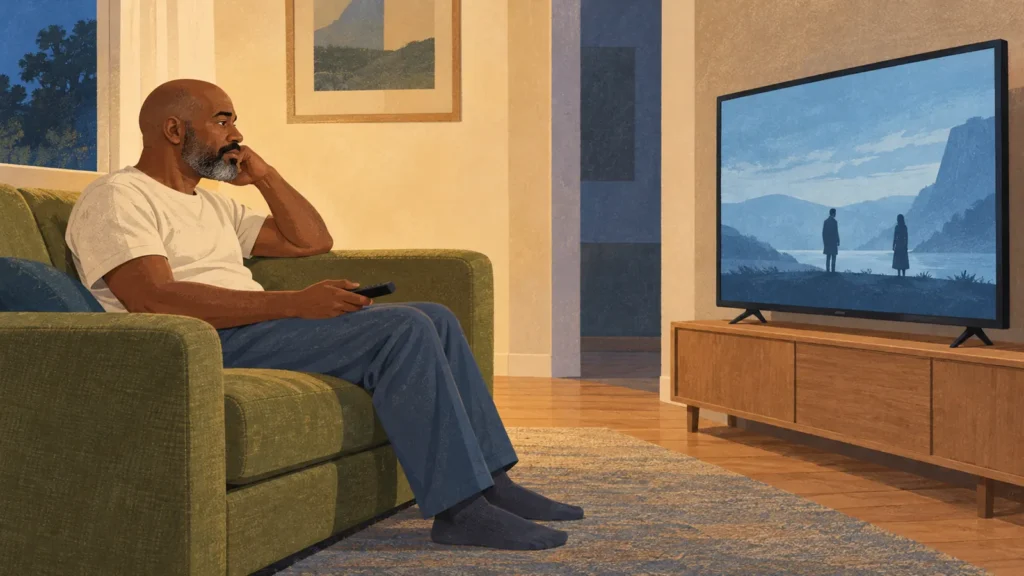
“It gets good.”
That recommendation leaves out the part you need most: good in what way? Does the next episode deepen a relationship you already care about, or does something finally explode after four hours of people looking worried?
If you’re deciding whether to keep watching a slow series, give it more time when you can name something you want more of. A character. An uneasy atmosphere. A conversation that changed how you understood the scene before it. Stop when your strongest reason to continue is that someone else promised your patience would eventually be rewarded.
That is a judgment about your evening, not a verdict on the show’s artistic worth. You can leave an excellent series unfinished.
Slow can still give you something now
Try looking back at the last episode without counting its plot twists. What did it give you?
Imagine a drama about two estranged sisters clearing out their childhood home. In one version, they spend an episode sorting possessions and avoiding an argument. Little happens, but one sister quietly sets aside an object she claimed not to remember. Suddenly you’re wondering what else she has concealed. The scene has changed your understanding of her, even though neither sister has left the house.
In another version, the sisters repeat the same disagreement and then the episode ends with a locked drawer. You may want to know what’s inside. But if you didn’t enjoy their company, the dialogue or the tension along the way, you’re being asked to wait for your main reward.
A quiet scene can give you plenty to think about. A busy episode can leave you feeling that nothing mattered.
You also don’t have to care about a character in the sense of liking them. Wanting to understand an infuriating person can be plenty of reason to return.
Does the Three-Episode Rule Actually Work?
In 2020, Crunchyroll asked anime fans whether they followed the three-episode rule. Give a new show three episodes, the thinking goes, and you’ll have a fair idea of what you’re getting. A year later, Crunchyroll was asking whether the rule had any substance or was anime folklore. Even as a trial period, three episodes can mean half of a six-episode season or barely a start on a twenty-episode one.
Netflix tried putting a number on “hooked” in 2015. For the series it looked at, Netflix counted how many viewers who reached a given episode went on to finish season one, using 70 percent as its cutoff. The reported averages varied. Breaking Bad landed at two, House of Cards at three, and How I Met Your Mother at eight. That tells you something about the people who made it that far. How much fun they were having is a different question. So is whether you’d want to watch another episode.
Then there’s the possibility that the show itself is still figuring things out. When The Seinfeld Chronicles aired in 1989, Jerry’s neighbor was called Kessler. A test audience had given the pilot poor marks. When the show returned the next year as Seinfeld, viewers met Elaine. You could have given that first episode a perfectly fair hearing and still missed a whole side of the show.
Three episodes can be a stopping point, and if the show changes, you can decide later whether to come back. For tonight, what the episodes gave you is a better guide than how many you’ve watched.
Before pressing play again, finish this sentence
“I want another episode because…”
Listen to the reason you supply:
- “I want to see how she handles what she just learned.” There’s a specific thread pulling you forward. Keep watching if you have the appetite for it.
- “I love being in this world, even when the story barely moves.” The experience itself is your reward. You don’t need to defend it with a plot summary.
- “I’m interested, but I couldn’t follow it tonight.” Pause. Give it another try when you can pay attention, if you still want to.
- “Everyone says the finale makes it worth it.” Find out what kind of payoff they mean before committing more time.
- “I’ve already watched three episodes.” That describes time spent. It doesn’t tell you what you want from the next one.
That last answer resembles the sunk-cost problem studied in decision research: allowing an investment already made to influence whether you invest more. The linked paper adds a useful complication: past investment can stand in for information you’ve forgotten. Applied to television, perhaps something hooked you at the start. If you can recover that reason, use it. The episode count itself isn’t one. This is an analogy, not a finding from a study of streaming viewers.
There’s an exception worth keeping: you might want to finish because discussing the series with a friend is part of the pleasure. That counts as a reason. Be honest about whether you enjoy that shared conversation or merely feel behind.
Ask a better question than “Does it get good?”
Tell the person recommending it what isn’t working, and ask for a spoiler-free answer.
“I like the setting, but the mystery feels stuck. Does the investigation start moving, or is the appeal mostly the characters?”
Or: “I’m enjoying the performances, but the violence is too much for me. Does that remain a big part of it?”
Those answers help you decide whether the show offers something you want. “The ending is amazing” doesn’t settle either question. And if the answer is that the feature you dislike remains central, you have useful information even if your friend loves it.
You can make the same distinction when reading a review: look for what the writer praises. Rich atmosphere is a reason to watch if atmosphere draws you in. It offers less reassurance if you’re waiting for a brisk mystery. Avoid episode recaps if preserving surprises matters to you.
Give an uncertain show one deliberate retry
If there’s a real point of interest but you’re undecided, choose a stopping point before you resume: the end of the next episode, for example. This is a practical boundary, not a claim that every series reveals its quality by a particular episode number.
At that point, ask whether you found more to enjoy or more you wanted to understand. You don’t need a revelation. A relationship becoming more complicated may be enough. If you’re still waiting for the show to become a different kind of show, stop.
You can also set it aside without making a permanent decision. “I don’t want this tonight” is enough. A demanding drama may suit a quieter weekend; you’re under no obligation to schedule that weekend now.
Which show did you finally quit, or stick with and not regret?